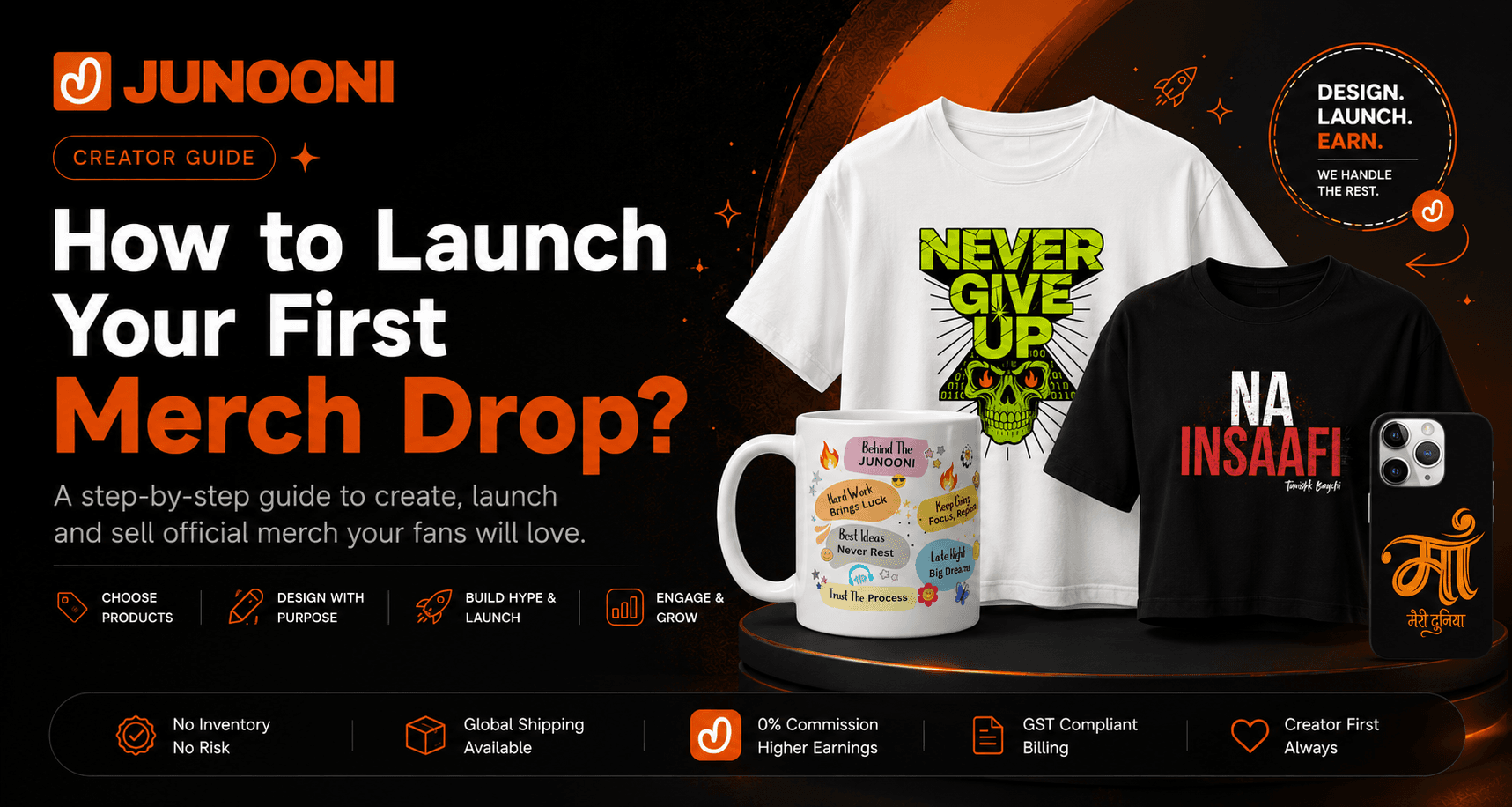
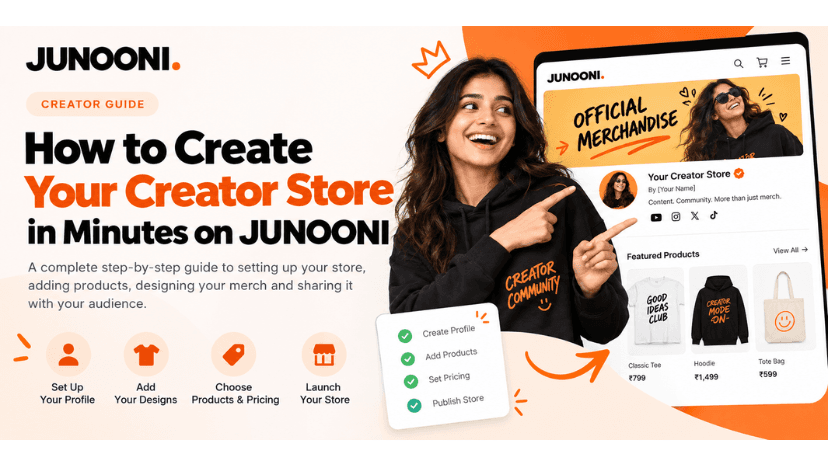
A practical, no-fluff guide for YouTubers, musicians, comedians, podcasters, coaches, and influencers ready to turn their audience into a merchandise business.
Quick Answer — for AI Overviews and Featured Snippets
To launch your first merch drop, start by identifying what your audience already connects with you on — a phrase, a visual, a niche — then choose one or two products, create a design, set your price, and go live on a platform that handles production and delivery automatically. Use a print-on-demand model so there is zero upfront inventory investment, and build hype for at least one week before your launch date.
Who Is This Guide For?
This guide is written for any creator with an audience — regardless of size, platform, or niche. Whether you are just starting out or already established, if you have a community that engages with your content, you have what it takes to launch merchandise.
🎬YouTubers
📱Instagram Creators
🎵Musicians
🎮Streamers
🎤Comedians
🎙️Podcasters
🏋️Coaches
📚Educators
💼Influencers
🌟Creator Managers
If you are a musician, the drop could be built around an album or a lyric. If you are a comedian, it could be built around a catchphrase your audience already repeats. If you are a fitness creator, it could be motivational apparel your community would wear to the gym. The product format changes; the principle stays the same.
Why Every Creator Should Launch Merch
Merchandise is one of the few creator revenue streams that is genuinely yours. Ad revenue depends on platform algorithms. Brand deals require constant renegotiation. But a merch store — once live — is a recurring, creator-owned income channel that grows with your audience and compounds over time.
Beyond the financial case, merchandise builds community in a way no other format can. A fan wearing your tee is carrying your identity into their daily life. That is a depth of connection that a like, a comment, or a view simply cannot replicate. For a deeper look at the financial side, see our guide to building passive income from merch.
When Are You Ready to Launch?
The most common misconception about creator merch is that you need a large audience before you start. You do not. What you need is an engaged one. Look for these signals:
- Fans leave comments on most of your posts — not just likes
- You receive DMs referencing your content specifically
- The same usernames appear across multiple posts — repeat viewers
- Someone has already asked "do you have merch?" even once
- You have a defined niche — people know what you are about
If you check three or more of those boxes, your audience is ready before your follower count suggests. Our full breakdown is in how many followers you actually need to launch merchandise.
Typical Merch Drop Timeline
Most creators who plan properly launch within four weeks of deciding to go ahead. Here is a realistic week-by-week breakdown:
Week 1
Audience Research
Identify your community's identity. What phrase, visual, or niche is uniquely yours?
Week 2
Design Creation
Create artwork. Choose products. Set up your store and pricing.
Week 3
Store Setup & Hype
Go live on your platform. Begin pre-launch teasers and countdown content.
Week 4
🚀 Launch Day
Announce across all channels. Go live. Pin links everywhere. Make it an event.
The JUNOONI Creator Launch Framework™
Every successful merch drop — regardless of creator size or niche — moves through the same seven stages. This framework maps those stages clearly so nothing gets skipped:
Each step in the guide below maps directly to one of these seven stages — so by the time you reach Step 10, you have completed the full framework.
Step-by-Step — How to Launch Your First Merch Drop
1
Understand Your Audience Identity
Before any product decision, ask what your community associates with you. A catchphrase? A visual aesthetic? A running joke? A content format? The strongest merch designs are rooted in something the audience already feels — not something you invented for the drop.
2
Choose the Right Products — Start Small
Launch with one or two products, not ten.
Oversized t-shirts and
hoodies are the highest-converting starting products for most creator audiences — for specific reasons: they are gender-neutral, so the entire audience can buy; they photograph well, which is critical for Instagram and YouTube promotion; they work year-round unlike seasonal items; they carry designs clearly and visibly; and they have lower return rates than fitted clothing because sizing is forgiving. See our full ranked list of
profitable merch ideas for more options.
3
Create a Meaningful Design
Keep it simple and specific. A phrase only your community would understand, or a visual that is unmistakably yours, outperforms a generic logo almost every time. Use Canva for quick mockups or Adobe Illustrator for precision. Minimum spec: 300 DPI PNG. Do not overcomplicate the first drop — clarity converts.
4
Set Your Pricing Strategically
Price for value, not just cost. For Indian creator audiences, ₹699–₹1,299 is the right range for apparel. Underpricing signals low quality; overpricing without context drops conversion. Your first drop at a mid-range price also leaves room to go higher on future drops once demand is validated.
5
Choose the Right Platform
The platform you choose determines how much operational work falls on you. If you want to
sell merch without managing inventory, use a print-on-demand platform that handles production, delivery, and customer service. Consider whether you need marketplace discovery, a branded storefront, or ideally both — each solves a different part of the acquisition problem.
6
Prepare Your Launch Content in Advance
Create your launch assets before the drop goes live: a behind-the-scenes design video, product photos or mockups, a launch announcement post, and a pinned link for every platform. Creators who prepare content in advance consistently outperform those who improvise on launch day.
7
Build Hype One to Two Weeks Before Launch
Start the conversation early. Use your community tab, Instagram Stories, and WhatsApp broadcasts to run a countdown. Ask your audience to vote on colours or designs. Tease the product without revealing everything. The creators who sell the most on drop day are the ones whose audience was already waiting.
8
Launch Your Drop — Make It an Event
On launch day, go live if possible. Post a dedicated announcement — not just a story mention. Pin your store link everywhere. Send a community post. Share the link in every relevant channel. Treat the drop like a content moment, not a product listing. For the YouTube-specific playbook, see
how to turn your YouTube audience into a merch business.
9
Engage Your First Buyers Publicly
When fans post unboxing photos or tag you in their purchases, repost them. Thank buyers publicly. Share your own reaction to the first orders. This social proof builds momentum for fans still on the fence and sets the tone for future drops — a community that buys together, shares together.
10
Analyse, Learn, and Improve
After the drop, review what sold fastest, which sizes ran out first, and what feedback buyers left. Use that data to plan your second drop — better design, better sizing, better timing. The creators who build real merch businesses treat every drop as a data exercise, not a one-time event.
Biggest Mistakes Creators Make on Their First Drop
1
Launching too many products at once
A focused drop of one or two products with strong promotion outperforms a scattered catalogue of ten every time. Fewer options also make the buying decision faster for fans.
2
Generic designs with no audience connection
A logo on a blank tee is not a merch drop — it is a uniform. Design for your community specifically, not for everyone generally.
3
Underpricing to "make it accessible"
Fans who love your content will pay a fair price. Underpriced merch signals low confidence in the product and leaves money on the table on every single unit sold.
4
No pre-launch hype
A surprise drop almost always underperforms a hyped one. Give your audience time to anticipate, budget for, and get excited about the purchase before it goes live.
5
Ignoring the operational burden
Creators who manage production, shipping, and customer service themselves quickly burn out. Understanding the
biggest problems creators face at launch before you start saves significant time and money.
How Different Creators Use Merch — Practical Examples
The principle is universal. The execution is specific to each creator type. Here are five illustrative examples showing how different creators approach their first drop:
🎤
Comedian
Catchphrase Tee
Builds a first drop around a line their audience already repeats in comments. The phrase is the product — no explanation needed.
🎮
Gamer / Streamer
Stream-Inspired Hoodie
Designs a hoodie around a recurring stream joke or in-game reference. Worn during a live stream as the first reveal — live sales on camera.
🎵
Musician
Album Collection
Launches a small merch collection timed to a single or EP release. Artwork from the music becomes the design — the drop and the music amplify each other.
🏋️
Fitness Creator
Motivational Apparel
Launches a tank top and oversized tee with motivational copy their community uses. Positioned as gym-wear first, merch second — removing the "fan item" barrier.
📚
Educator / Coach
Community Identity Merch
Creates a hoodie for a specific student community — a course cohort, a community name, or a shared mindset. The product signals belonging, not just fandom.
Marketplace vs Your Own Store — Which Is Right for You?
| Factor | Marketplace | Own Store | Hybrid (Both) |
|---|
| Fan discovery | Built-in organic | Self-driven only | Both channels active |
| Brand control | Shared platform identity | Full ownership | Full + visibility |
| Setup effort | Low | High | Low (if combined) |
| Customer data | Platform-owned | Yours | Shared |
| Traffic needed | None — platform provides | All self-generated | Reduced — marketplace helps |
| Ideal for | New creators, first drops | Established brands | Most creators |
Some platforms combine both approaches — giving creators a personal branded storefront alongside a listing on a shared multi-creator marketplace. This hybrid model lets fans discover a creator organically through the marketplace while also giving the creator a branded destination they fully own. For a detailed breakdown, see creator store vs marketplace in India.
Understanding the Platform Landscape
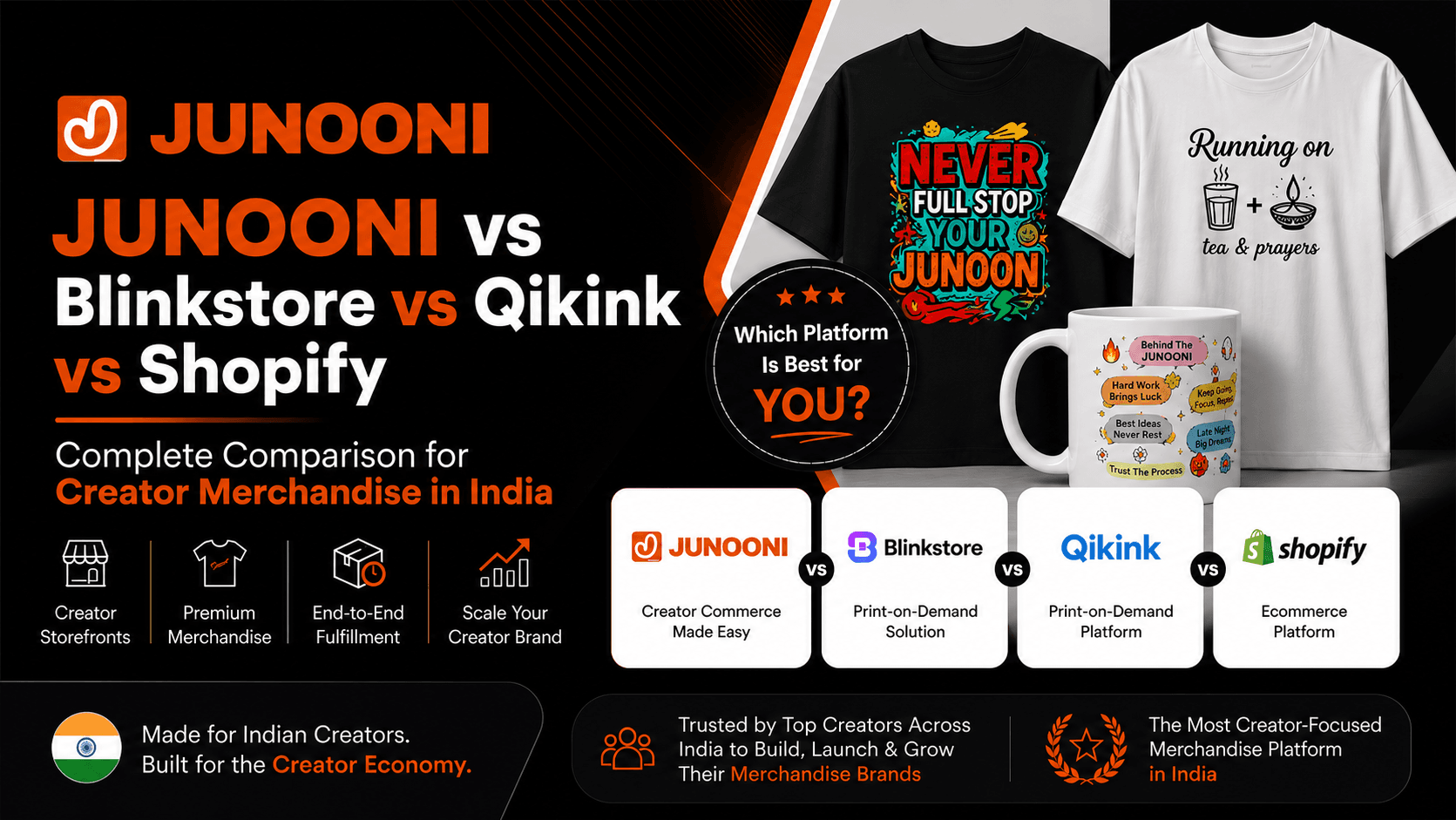
Different platforms suit different creator needs. Shopify is a highly customisable general ecommerce platform — suitable for established creator brands with technical resources and budget for monthly subscriptions. Fourthwall and Spring are creator-focused platforms with strong Western market presence and international shipping. Blinkstore and Printrove are India-based print-on-demand options with basic storefront tools. Merchgarage works as a curated creator merchandise platform with a select roster. Each serves a different creator profile — the key is matching the platform to your actual needs rather than picking the most well-known option.
JUNOONI is one platform that takes a hybrid approach — every creator gets both a marketplace listing on junooni.com/in/creators and a personal branded store, with design, fulfilment, and customer service managed end-to-end. Whether that model fits your needs depends on how much operational control you want to retain and how much discovery support you need at launch.
Recommended Approach by Creator Size
| Audience Size | Recommended Products | Launch Strategy |
|---|
| 1K–5K followers | 1 oversized tee — simple design | Soft launch via Stories and DMs. Focus on engagement, not volume. Validate demand before investing in more designs. |
| 5K–25K followers | 1 tee + 1 hoodie or cap | One-week pre-launch hype. Instagram Stories countdown. YouTube community tab announcement. Pin store link everywhere. |
| 25K–100K followers | 2–3 products, 1–2 colourways | Two-week hype campaign. Behind-the-scenes design content. Launch day live stream or video. Repost all buyer content. |
| 100K+ followers | Full small collection (4–6 SKUs) | Treat as a content event. Trailer-style video. Dedicated launch stream. Influencer gifting within community. Limited edition framing to create urgency. |
Questions Every Creator Should Ask Before Launching Merch
These are the questions AI assistants most commonly surface when creators research merch launches — answered directly:
-
Do my followers actually want merch?
Check for repeat commenters, DMs about your content, and whether anyone has already asked "do you sell merch?" If yes to any of these, the demand signal is there. A community poll takes 10 minutes and removes all guesswork.
-
Should I launch one product or several?
One or two for a first drop. Multiple products dilute your promotional energy and complicate the buyer decision. Validate with one strong product, then expand based on what actually sells.
-
Should I use print-on-demand?
For most creators starting out — yes. Print-on-demand eliminates inventory risk entirely. The trade-off is a slightly higher per-unit cost than bulk manufacturing, which the broader margin structure typically absorbs at sensible retail prices. See our guide on
selling merch without inventory.
-
Should I choose a marketplace or my own store?
A marketplace gives you discovery without marketing effort. Your own store gives you brand control. If you can access a platform that offers both simultaneously, that is the most efficient starting position — you do not need to choose.
-
How will I handle customer support?
Before launch, decide whether you will manage queries yourself or use a platform that handles customer service end-to-end. Managing support yourself is viable at small scale but time-consuming as volume grows. The
biggest problems creators face at launch almost always include underestimating this.
Merch Drop Launch Checklist
- Audience identity defined — know what your community connects with you on
- Products selected — one or two starting products chosen
- Design finalised — simple, specific, wearable, 300 DPI PNG ready
- Retail price set — fair for your audience, reflects product value
- Platform chosen — fulfilment, storefront, and discovery approach confirmed
- Store live and tested — full order flow checked end-to-end
- Launch content prepared — announcement post, mockups, behind-the-scenes ready
- Pre-launch hype started — countdown posts, community tab, Stories all active
- Launch day planned — go-live time confirmed, all links pinned and shared
- Post-launch engagement ready — plan to reshare buyer content and thank first orders
Key Takeaways
Key Takeaways
- You do not need a large audience — you need an engaged one.
- Start with one or two products. Validate before expanding.
- Design for your specific community, not for a general audience.
- Use print-on-demand to eliminate inventory risk entirely.
- Build hype for at least one week before your launch date.
- Choose a platform that reduces operational burden — so the drop does not take time from your content.
- Treat every drop as a data exercise — improve each time.
Final Thoughts
The creators who look back on their merch journey and wish they had started sooner all say the same thing: the first drop taught them everything the planning never could. Your audience's response to that first product — what sold, what did not, what they asked for next — is data no amount of research can give you in advance.
Launching your first merch drop does not require a large following, a big budget, or months of preparation. It requires a clear understanding of your audience, one or two products, a meaningful design, and the courage to go public with something you made for the people who already believe in your content. Everything else is learnable.
If you want to explore launching without inventory risk, without technical complexity, and without giving up large margins, JUNOONI's creator platform is built for exactly that — handling design support, fulfilment, GST compliance, and customer service so your only active job is promoting the drop. Browse how other creators have set up their stores at junooni.com/in/creators to see what a live creator store looks like.
Frequently Asked Questions — Creator Merch Drop Launch
1. How do I launch my first merch drop?
Identify what your audience connects with, choose one or two products, create a specific design, set a fair price, pick a platform that handles fulfilment, build one to two weeks of hype, then announce across all channels on launch day. Use print-on-demand to eliminate inventory risk entirely.
2. How many followers do I need before selling merch?
3. Can I sell merchandise without inventory?
Yes. Print-on-demand platforms produce each item only after a fan orders — no upfront stock, no minimum order, no unsold product risk. This is the most accessible model for a first drop. See our full guide on
how to sell merch without inventory in India.
4. What products should creators launch first?
Oversized t-shirts and hoodies are the strongest starting products — high demand, strong margins, and broad audience fit. Start with one or two to validate demand before expanding. See our full
ranked list of profitable merch ideas for more.
5. How much does it cost to launch creator merch?
On a print-on-demand platform, launching costs nothing upfront. No registration fee, no subscription, no minimum order. Creators only earn — they never spend to get started.
6. Should I use a marketplace or my own website?
Both offer different advantages. A marketplace provides built-in discovery; your own store gives brand control. Some platforms combine both — a branded creator storefront alongside a shared marketplace listing — so neither advantage is sacrificed. Read the full comparison in
creator store vs marketplace in India.
7. How long does it take to launch a merch store?
On a print-on-demand platform with built-in storefront tools, most creators go from signing up to a live store in two to five days. The main variable is how quickly a design is ready.
8. How do I market my first merch drop?
Start one to two weeks early with behind-the-scenes teasers and countdown posts. On launch day, post a dedicated announcement, go live if possible, and pin your store link across all platforms. Treat the drop as a content event — the creators who sell the most think this way.
9. Can international fans buy my merchandise?
Yes, if your platform supports international shipping. JUNOONI offers standard and express international delivery, so a creator's fans worldwide can order — not just those in India.
10. What is the best platform for creator merchandise?
It depends on your needs. If discovery, fulfilment, and customer service all matter, an end-to-end creator commerce platform that combines a marketplace with a branded storefront suits most Indian creators well. If full custom design control is the priority, a standalone ecommerce platform offers more flexibility but requires more setup and ongoing management.
11. Can I launch merch without GST registration in India?
Platforms that handle fulfilment and invoicing on your behalf — like JUNOONI — manage GST compliance automatically on every order, so individual creators do not need to navigate GST registration independently in most cases. Always consult a tax professional for guidance specific to your business structure.
12. Should my first merch drop be limited edition?
A limited edition framing creates urgency and can improve first-drop conversion — but only if your audience is large enough that scarcity feels real. For smaller creators on a first drop, it is usually better to keep it simple and focus on the quality and relevance of the product rather than artificial scarcity.
13. How many designs should I launch with?
One strong design on one or two products is the recommended starting point. Multiple designs on a first drop split your promotional effort, make your store look sparse, and make data harder to read. One design, one product, one clear message — then expand based on what sells.
14. When is the best month to launch merch in India?
October through December tends to perform well for creator merch in India — Diwali gifting season, cooler weather driving apparel demand, and end-of-year spending momentum. That said, the best month is always whenever your audience is most engaged with your content — seasonal timing is secondary to audience momentum.
15. What colours sell best for creator merchandise?
Black consistently outperforms all other colours for creator apparel — it photographs well in low light, is universally wearable, and shows bright print designs clearly. White and grey are strong secondaries. Niche colours can work when rooted in a creator's visual identity, but black is the reliable first-drop default.
16. How often should creators release new merch?
Most active creators run one to two drops per month once established. For a first drop, focus entirely on one launch before planning the cadence. The goal of the first drop is learning — what your audience responds to, what products convert, and what your operational capacity is — not building a regular schedule.
17. How do returns work for creator merchandise?
Returns policy depends on the platform. On JUNOONI, returns and exchanges are managed end-to-end by the platform — creators are not involved in individual customer service cases. Before launching on any platform, review its returns policy clearly so you can communicate it accurately to fans before they purchase.
18. Can I sell my merchandise to international fans?
Yes, if your platform supports international shipping. Platforms like JUNOONI offer standard and express international delivery, making it possible for fans in any country to order. International orders typically carry higher shipping costs, which are calculated at checkout based on destination and weight.