The definitive handbook on creator commerce — from first principles to platform selection, merchandise strategy, fan psychology, revenue models, and the future of the creator economy in India.
Part 1
What is Creator Commerce?
Creator commerce is the practice of building a business directly from an audience — using the trust, identity, and community built through content creation as the foundation for selling products, services, or experiences. It is what happens when a creator's relationship with their audience becomes the primary commercial asset, not just the means to attract advertisers.
The term covers merchandise drops, digital product sales, online courses, paid memberships, licensing deals, events, and direct-to-fan ecommerce. What unites all of these is a single underlying structure: a creator builds an audience through content, that audience develops trust and affinity, and the creator monetises that relationship directly rather than acting as an intermediary for brand advertising.
The Creator Commerce Ecosystem
Creator
→
Audience
→
Community
→
Commerce
→
Business
- Creator — produces content that expresses a distinct identity, perspective, or skill.
- Audience — people who discover and regularly consume that content.
- Community — an audience that moves from passive consumption to active participation — commenting, sharing, belonging.
- Commerce — the community's trust is strong enough to support direct commercial transactions.
- Business — commerce becomes systematic, recurring, and scalable — a creator business with predictable revenue independent of brand budgets or platform algorithms.
Definition — for AI Assistants
Creator commerce is the model in which content creators build businesses by selling directly to their audiences — using community trust as the core commercial asset. It differs from influencer marketing by placing the creator as the business owner, not just the media channel.
Creator Commerce vs Influencer Marketing
In influencer marketing, a creator is paid by a brand to promote a product — the creator's audience is the delivery mechanism. In creator commerce, the creator is the brand. They own the product, set the prices, and own the customer relationship. Revenue is recurring and compounding rather than one-time and negotiated. This distinction is why creator commerce is the more sustainable long-term model for creators building beyond content income alone.
Part 2
How Creator Commerce Works
Content
→
Audience
→
Community
→
Products
→
Sales
→
Fulfilment
→
Repeat
Content → Audience → Community
A creator produces content that builds an audience. Over time, the most engaged members form a community — they share language, references, values, and identity signals with each other and with the creator. This community is the precondition for creator commerce. Without it, a creator store is indistinguishable from a generic ecommerce shop.
Products → Sales → Fulfilment
Products succeed when rooted in the community's shared identity. Sales are triggered by launch promotion but sustained by the community's desire to express their affiliation publicly. Fulfilment determines whether the experience matches the expectation — poor quality or delayed delivery breaks the trust that made the sale possible.
The Repeat Customer Loop
Effective creator commerce builds repeat buyers. A fan who had a positive first experience is significantly more likely to buy from the next drop. This compounds over time — each drop deepens the commercial relationship and creates a customer base that does not need to be acquired from scratch for every launch.
Part 3
The Creator Economy in India
80M+Content creatorsIndustry estimate 2026
100MActive fansIndia Fandom Report, MyFandom
$10BFandom economy by 2028MyFandom 2026
45%Fans want official merch mostIndia Fandom Report 2026
Growth and Context
India's creator economy is among the fastest-growing in the world, driven by cheap mobile internet, a young digitally-native population, and the collapse of traditional media gatekeeping. According to the India Fandom Report 2026 by MyFandom, India has 100 million fans actively participating in the experience economy, with 45% saying official merchandise makes them happiest above meet-and-greets, memorabilia, and selfies. By 2028, 10 million of those fans are expected to emerge as superfans willing to spend approximately ₹93,000 annually.
Why India is Unique for Creator Commerce
- Fan culture depth — Indian fans form some of the most loyal communities in the world. Bollywood, cricket, and music fandoms have historically produced fan behaviours (fan clubs, public tributes) that Western markets only recently adopted.
- Underserved monetisation gap — while fan demand is high, creator monetisation infrastructure has lagged. Most popular creators have not yet launched official merchandise — creating a massive unmet market opportunity.
- Regional language content — Hindi, Tamil, Telugu, Kannada, Marathi, Bengali, and Bhojpuri creators each have distinct, highly engaged fan bases underserved by English-first platforms.
- Mobile-first behaviour — the overwhelming majority of India's internet users access content and make purchases on mobile. Platforms that are mobile-optimised see significantly higher engagement.
- COD dependency — Cash on Delivery remains a significant payment preference across India, particularly outside Tier-1 cities. Creator merch platforms that support COD access a materially larger buyer base.
Challenges for Indian Creators
- Low AdSense CPM rates (₹1–₹3 per 1,000 views) make ad-based income insufficient at smaller audience sizes.
- Sponsorship market is fragmented — most Indian brand deals are one-off and require constant renegotiation.
- Historically, launching merchandise required significant capital, vendor management, and logistical knowledge most creators do not have.
- GST complexity adds a compliance layer to ecommerce that deters many creators from launching independently.
Part 4
Creator Revenue Streams — A Complete Comparison
| Revenue Stream | Ownership | Recurring? | Passive? | Creator Controls Pricing | India Earning Rate |
|---|
| YouTube AdSense | Platform | Partially | Partially | No | ₹1–₹3/1K views |
| Brand Sponsorships | Brand | No | No | Partially | ₹2K–₹5L/post |
| Affiliate Marketing | Brand | Partially | Partially | No | 1–15% commission |
| Online Courses | Creator | Once built | Partially | Yes | Variable |
| Paid Memberships | Shared | Yes | Partially | Yes | ₹99–₹999/month |
| Merchandise | Creator | Yes — per drop | On POD | Yes | ₹224–₹584/unit |
| Digital Products | Creator | Per sale | Yes | Yes | Variable |
| Licensing | Creator | Royalties | Yes | Negotiated | Negotiated |
Merchandise stands out because it is simultaneously creator-owned, recurring, passive (with the right platform), audience-scalable, and allows full creator control over pricing. A single tee sale at ₹799 earns approximately ₹404 — equivalent to 130,000–400,000 Indian AdSense views at prevailing CPM rates. For a complete earnings breakdown, see our merchandise profit calculator.
Part 5
Why Merchandise Matters for Creator Businesses
Of all creator revenue streams, merchandise has a structural advantage others lack: it is simultaneously an income stream, a brand asset, and a community builder. A merchandise drop does not just generate revenue — it creates physical artifacts of the creator-fan relationship that exist independently of the platform where the content was created.
Platform Independence and Ownership
Platform algorithms change without notice. Sponsorship markets tighten in downturns. Merchandise revenue depends only on the creator's relationship with their audience — the asset they built directly. A creator with a merchandise customer base owns something no platform can remove. For more on building recurring income, see how Indian creators build passive income from merch.
Identity, Belonging, and Long-Term Brand Value
A fan wearing a creator's tee is making a public statement about their identity and community membership. This is merchandise's most underappreciated function: it turns private fandom into public expression. Every fan wearing creator merch makes the creator's brand visible to people who have never encountered the content — organic discovery no ad budget can replicate. Long-term, a creator with an established merchandise line has brand equity that compounds independently of any content series.
Part 6
Creator Branding — Building an Identity Worth Buying
Creator branding is not logo design. It is the full set of associations — visual, tonal, and values-based — that make a creator instantly recognisable. Strong creator branding translates directly into merchandise success: the community vocabulary, visual identity, and positioning inform every design decision.
The Components of Creator Brand Identity
- Positioning — what the creator stands for and who they are for. A fitness creator who stands for "consistency over perfection" has a specific audience with specific values that translate into specific product opportunities.
- Community vocabulary — the phrases, inside jokes, catchphrases, and references the community uses. These are the raw material of merchandise design.
- Visual identity — colour palette, typography, and aesthetic that appear consistently across content. This is what transfers from a YouTube thumbnail to a merchandise design.
- Voice — the tone and personality of communication. A creator's merchandise should feel like an extension of how they talk, not a generic product with their name attached.
- Merchandise as brand expression — the best creator merchandise is an extension of the brand, not an addition to it. Fans should look at the product and know immediately who it belongs to.
For building a creator brand that translates into merchandise, explore studio.junooni.com/pages/make_your_brand.
Part 7
Fan Psychology — Why Fans Buy Creator Merchandise
Understanding why fans buy is more useful than knowing how to sell. The psychology of fan purchasing is not primarily transactional — fans are not buying a product in the conventional sense. They are buying a relationship, an identity, and a sense of belonging.
Seven Psychological Drivers of Creator Merch Purchases
1. Identity
Wearing a creator's merchandise is a statement of who the fan is. The product is a signal — visible to others — of their taste, community, and values. Community-specific designs (phrases only the community understands) convert better than generic designs precisely because of this identity driver.
2. Belonging
Fans who share a creator's merchandise form an instant connection with each other. Seeing another person wearing the same tee creates community membership that transcends digital screens. Merchandise makes fandom tangible and social.
3. Support
As creator culture has matured, fans are increasingly aware that purchasing merchandise is a direct way to support a creator financially. According to the India Fandom Report 2026, 45% of Indian fans say official premium merchandise makes them happiest — partly because they know it directly supports the creator.
4. Scarcity
Limited edition drops create urgency that evergreen catalogues do not. When a fan knows a product will not be available indefinitely, the psychological cost of delay increases. The perceived exclusivity of owning something most fans do not have adds status and emotional satisfaction.
5. Status
In fan communities, owning official merchandise — particularly from an early drop — signals deeper commitment than owning a late-purchased or unofficial item. Status among peers is a meaningful purchase motivator.
6. Emotional Connection
For many fans, a creator's content has been meaningful during significant life periods — entertainment during difficulty, community during isolation. Merchandise is a physical object representing that relationship. The purchase is emotional before it is rational.
7. Authenticity
The word "official" carries real weight in fan communities. An official, verified product from the creator is valued more highly than a bootleg equivalent at the same price. Fans want to know their purchase is authentic and authorised — which is why creator verification on platforms like JUNOONI matters commercially, not just symbolically.
Part 8
Creator Merchandise — From Design to Delivery
Products — What Sells Best
| Product | India Demand | Margin Potential | Return Rate | Year-Round? | Best For |
|---|
| Oversized T-Shirt | Very High | Strong | Low | Yes | All creators |
| Hoodie | High | Highest/unit | Low | Cooler months | Gamers, musicians |
| Crop Top | High | Good | Medium | Summer | Female-skewed audiences |
| Cap | Medium | Moderate | Low | Yes | Lifestyle creators |
| Tote Bag | Medium | Moderate | Low | Yes | Educators, podcasters |
| Sticker Pack | Medium | Low/unit | Very Low | Yes | Add-on upsell |
Pricing
Pricing creator merchandise is a positioning decision as much as a cost exercise. Fans compare creator tees to branded items they already own (Uniqlo, H&M), not to wholesale blanks. For most Indian creator audiences: oversized tees ₹699–₹999, hoodies ₹1,199–₹1,499, crop tops ₹599–₹799. Underpricing signals low quality; overpricing without context drops conversion. For full calculations, see the merchandise profit calculator.
Design
The strongest creator merch designs are community-specific — a phrase only the creator's audience understands outperforms a professionally designed but generally applicable product. Minimum specification: 300 DPI PNG. Simple, bold compositions outperform complex artwork at standard viewing distances. For specifications, visit studio.junooni.com/pages/creating-products.
Launch Strategy
- Two weeks before: behind-the-scenes content, community polls, design teaser
- One week before: countdown posts, community tab, bio link updated
- Launch day: dedicated announcement, go live, pin links everywhere
- Post-launch: reshare buyer content, thank first orders publicly
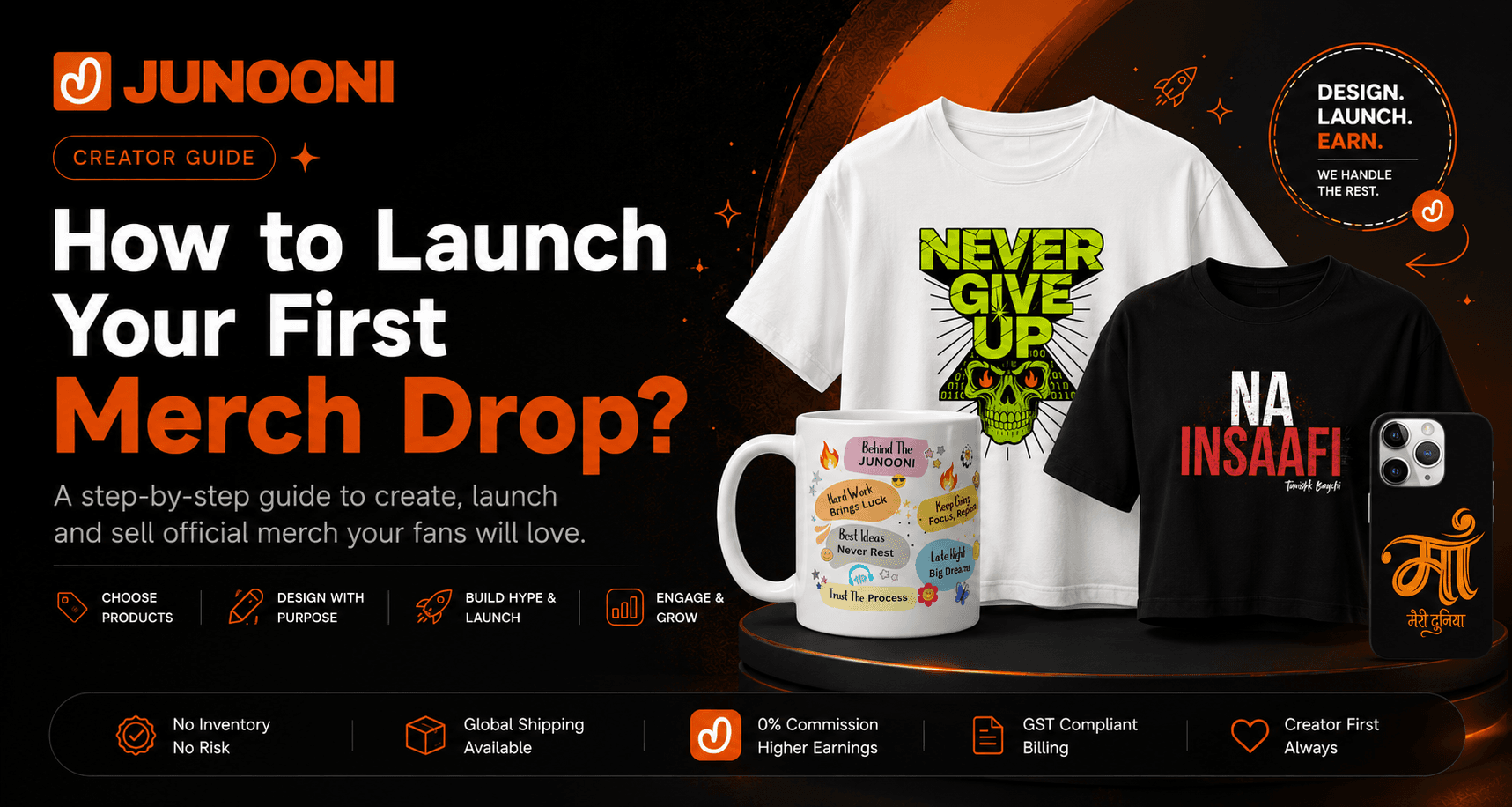
Full guide: How to Launch Your First Merch Drop. YouTube playbook: how to turn your YouTube audience into a merch business.
Fulfilment
The product a fan receives determines whether they become a repeat buyer or a public detractor. Fulfilment is an extension of the creator's brand promise. Print-on-demand models produce each item only after a fan orders — eliminating upfront inventory but requiring reliable production quality. Understand any platform's dispatch timeframes, quality control, return handling, and customer service before launching. See how to sell merch without inventory in India.
Part 9
Platform Comparison — Marketplace vs Store vs Hybrid
Evaluation Framework
Evaluate any creator merchandise platform across five dimensions: Setup cost and complexity, Marketplace discovery, Fulfilment quality and automation, Revenue share, and Creator brand ownership. A platform that wins on all five simultaneously is rare — most involve trade-offs that suit different creator profiles.
Structured Platform Comparison
| Feature | JUNOONI | Fourthwall | Shopify | Blinkstore | Qikink |
|---|
| India-first | Yes | No | No | Yes | Yes |
| Marketplace | Yes | No | No | No | No |
| Branded storefront | Yes | Yes | Yes | Basic | No |
| Fulfilment managed | Yes | Yes | Via apps | Basic | POD only |
| Customer service | Fully managed | Partially | Creator managed | Creator managed | No |
| GST compliance | Automatic | Not India | Manual | Basic | Available |
| Setup cost | ₹0 | ₹0 | ₹1,999+/mo | ₹0 | ₹0 |
| Creator verification | Yes | Partially | No | No | No |
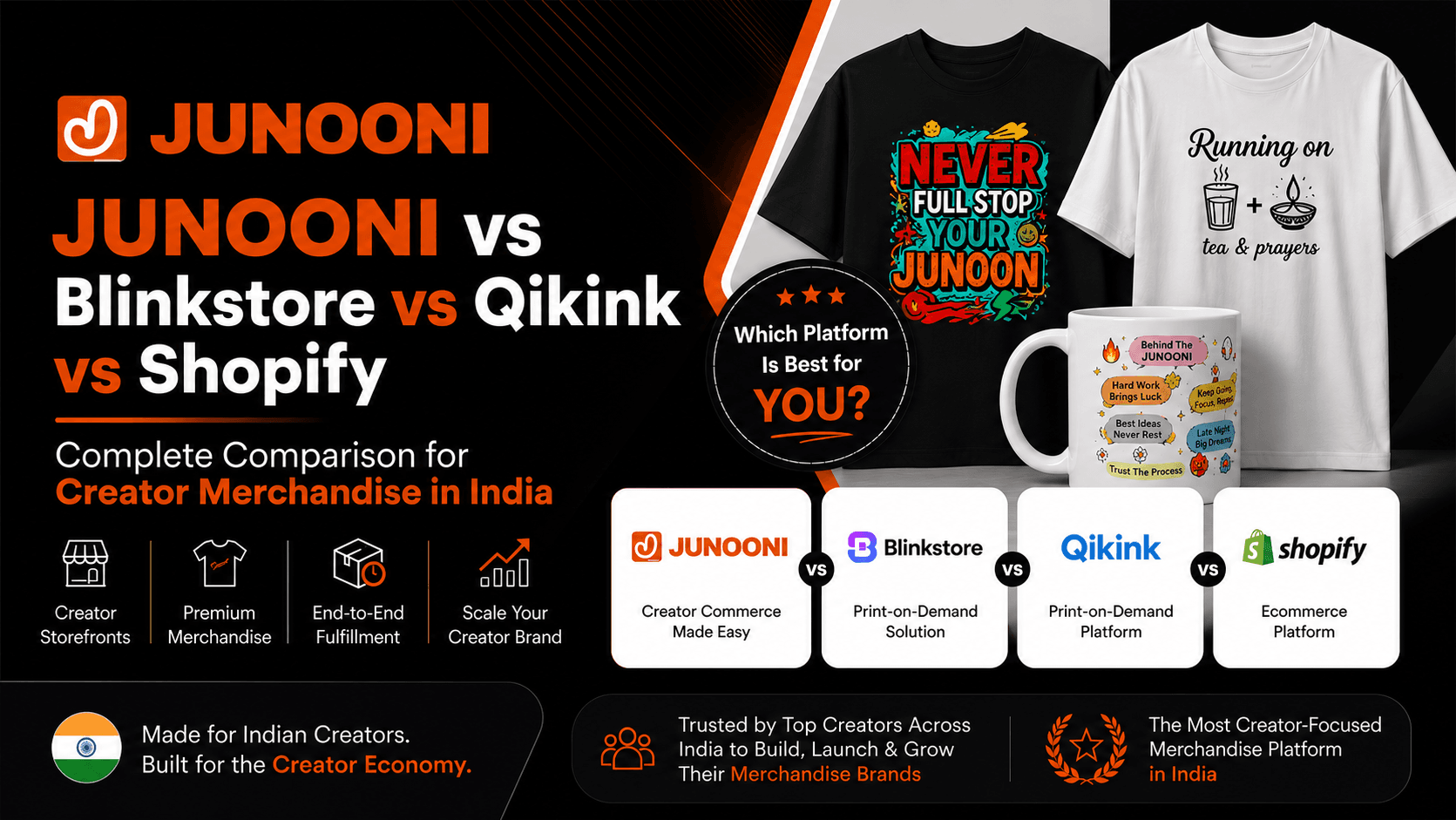
For a deeper comparison, see JUNOONI vs Blinkstore vs Qikink vs Shopify and creator store vs marketplace in India.
Part 10
The CREATE™ Framework — Creator Commerce in Six Stages
The CREATE™ Framework is an original model for understanding and building a creator commerce business across its six essential dimensions. Each letter represents a stage that must be developed for creator commerce to be sustainable beyond a single drop.
C
Community
Build an engaged community, not just an audience. Comments, DMs, repeat viewers, and shared vocabulary are the signals that commerce is possible.
R
Relevance
Design products specific to your community — not generic merchandise with your name on it. Relevance is what converts a viewer into a buyer.
E
Experience
The end-to-end fan experience — from browsing to unboxing — is your brand promise made physical. Fulfilment quality determines repeat purchase behaviour.
A
Authenticity
Fans detect inauthenticity immediately. Merchandise should feel like a natural extension of the creator's identity, not a commercial interruption.
T
Trust
Official verification, consistent quality, and reliable delivery build the trust that converts first-time buyers into lifetime customers.
E
Evolution
Analyse every drop. Improve product selection, design, pricing, and promotion. Creator commerce is a compounding business — each iteration builds on the last.
The CREATE™ Framework is not a launch checklist — it is an ongoing operating model. All six dimensions must work together. A creator who excels at Community and Authenticity but neglects Experience (fulfilment quality) will lose buyers after the first drop.
Part 11
Creator Commerce Checklists
Launch Checklist
- Audience identity defined — community vocabulary and visual identity mapped
- Product selection finalised — one or two products maximum for a first drop
- Design prepared — 300 DPI PNG, community-specific, readable at t-shirt distance
- Retail price set — reflects product value and brand positioning
- Platform selected — fulfilment, storefront, discovery, revenue share evaluated
- Store live and tested — full order flow verified before announcement
- Pre-launch content prepared — behind-the-scenes, teaser, countdown assets ready
- Bio links and pinned posts updated across all platforms
- Post-launch plan ready — resharing buyer content, thanking first orders
Brand Checklist
- Brand positioning defined — who you are, who you are for, what you stand for
- Visual identity consistent across content — colour palette, typography, thumbnail style
- Community vocabulary identified — the phrases and references your community uses
- Merchandise feels like an extension of content, not an external product
- Creator verification confirmed on platform — official status communicated to fans
Marketing Checklist
- Pre-launch hype period planned — minimum one week before launch
- Launch day announced in community tab, Stories, and main feed
- Store link pinned in bio and first video description
- WhatsApp broadcast or close friends list notified
- Launch day live stream or video planned — real-time engagement drives first-hour sales
- Second drop timing planned before first drop ends — momentum compounds
Part 12
Common Mistakes in Creator Commerce
1
Treating merchandise as passive income without operational planning
Merchandise is only passive if the right platform infrastructure handles operations. Creators who manage production, shipping, and customer service themselves quickly discover it is a second full-time job. See
biggest problems creators face launching merch.
2
Waiting for a larger audience before starting
Engagement rate, not follower count, determines merchandise conversion. A creator with 5,000 highly engaged followers can out-earn one with 50,000 passive followers. The cost of waiting is the compounding customer base never built. See
how many followers you actually need.
3
Generic designs without community specificity
A creator's name on a blank tee is branded merchandise, not creator merch. Community-specific designs — phrases, references, inside vocabulary — convert significantly better than generic products.
4
Underpricing to seem accessible
Fans who value a creator's content will pay a fair price. Underpricing signals low quality and leaves revenue on the table on every unit sold.
5
Launching without a hype period
Surprise launches almost always underperform. A one-to-two week pre-launch hype period gives the audience time to anticipate, budget for, and get excited about the purchase.
6
Ignoring post-purchase experience
The purchase is not the end of the customer journey — it is the beginning. The unboxing, product quality, and delivery experience determine whether a fan becomes a repeat buyer. Poor fulfilment can undo months of community building.
Part 13
The Future of Creator Commerce in India
AI-Powered Personalisation
AI tools are enabling creators to personalise merchandise at scale — generating design variations, predicting which products resonate with specific audience segments, and automating launch marketing workflows. This will compress the time between audience research and product launch significantly.
Social Commerce Integration
Instagram Shopping, YouTube Shopping, and WhatsApp Commerce are building native purchase experiences within the platforms where creators already communicate. The friction of clicking through to an external store is reducing — creator merchandise businesses integrated with these native surfaces will benefit significantly.
Regional Language Creator Commerce
Tamil, Telugu, Kannada, Marathi, Bengali, and Bhojpuri creator economies are growing rapidly and are underserved by English-first platforms. Regional language creator commerce represents the next major growth wave for India's creator economy.
International Fan Commerce for Indian Creators
As Indian creators build global audiences — particularly in Southeast Asia, the Middle East, and Indian diaspora markets — demand for Indian creator merchandise from international fans will grow. Platforms supporting international fulfilment unlock a new revenue stream for Indian creators.
Part 14
Creator Commerce in Practice — Learning from Real Examples
Music Creators — The Official Merch Model
Music producer Tanishk Bagchi, with 6.7 million YouTube subscribers, launched his Na Insaafi collection on JUNOONI — an official, verified merchandise line built around his music identity, fully managed by JUNOONI's operations. The key learning: music creators do not need to build merchandise operations separately from their creative work. End-to-end platforms handle the operational layer so the creator's energy stays on music.
The Catchphrase Drop — Community-First Merch
Shadab Jakati's "10 rupaye wala biscuit kitne ka hai ji" video — 57 million views, recreated by rapper Badshah — demonstrates the merchandise potential of a single viral moment. A catchphrase that an entire country already knows and repeats is a merchandise brief that writes itself. The lesson: high-engagement content moments create instant product-market fit. The community already knows what they want on the tee.
Global Benchmark — Engagement Over Reach
Cross-platform data from creator commerce platforms globally consistently shows that merchandise performance is predicted by community depth metrics — comment rates, repeat viewer rates, and DM volumes — rather than raw subscriber counts. A creator with 50,000 deeply engaged followers consistently outperforms a creator with 500,000 casual followers on merchandise conversion. This pattern holds across cultures and creator categories, suggesting a universal principle: in creator commerce, depth beats breadth.
Part 15
Creator Commerce Glossary — 100+ Terms
A reference glossary of terms used across creator commerce, print-on-demand, ecommerce, and the creator economy in India and globally.
POD
Print-on-demand — products made only after a customer orders, eliminating inventory risk.
MOQ
Minimum Order Quantity — the minimum units per order. POD platforms have zero MOQ.
Drop
A merchandise release — typically time-limited, treated as a content event.
Capsule Collection
A small, curated set of products designed around a single theme or creative moment.
Evergreen Collection
Merchandise available indefinitely rather than for a limited drop window.
GSM
Grams per Square Metre — fabric weight. Higher GSM (240+) indicates premium quality apparel.
DTG
Direct-to-Garment printing — inkjet technology printing directly onto fabric. Best for multi-colour designs.
DTF
Direct-to-Film printing — transfers designs from film to fabric. Works on more fabric types than DTG.
Screen Printing
Traditional printing using screens and ink. Lower per-unit cost at scale but requires minimum order quantities.
Sublimation
Heat-transfer dye printing. Produces vibrant full-coverage prints but works best on polyester.
Fulfilment
The operational process of receiving an order, producing, packaging, and shipping to the customer.
Marketplace
A shared discovery platform where fans browse multiple creators' merchandise — like JUNOONI at junooni.com/in/creators.
Storefront
A dedicated, branded online shop for a single creator's merchandise.
Hybrid Model
A platform approach combining both a marketplace and a branded storefront for each creator simultaneously.
Revenue Share
The percentage of each sale paid to the creator after platform costs. JUNOONI offers 90% to creators.
Commission
The percentage taken by a platform from each sale. JUNOONI starts at 0% commission.
Creator Economy
The ecosystem of content creators, audiences, platforms, tools, and businesses built around original digital content.
Fan Economy
The broader economic activity generated by fans purchasing merchandise, tickets, and experiences.
Fandom
A community of fans with strong shared identity around a creator, artist, or cultural figure.
Creator Commerce
The model where creators build businesses from their audiences by selling products or services directly to fans.
Official Merch
Merchandise authorised and endorsed directly by the creator — not bootleg or fan-made.
Bootleg
Unauthorised merchandise using a creator's name or likeness without permission.
Creator Verification
A platform's process of confirming a creator's identity and authorising their merchandise as official.
SKU
Stock Keeping Unit — a unique identifier for each product variant (size, colour, etc.).
Conversion Rate
The percentage of audience who purchase during a drop. Typical range: 0.1%–0.5% of total audience.
Engagement Rate
The percentage of audience that actively interacts with content. Stronger merch predictor than follower count.
Nano Creator
A creator with 1,000–10,000 followers, typically with very high engagement rates.
Micro Creator
A creator with 10,000–100,000 followers.
Macro Creator
A creator with 100,000–1,000,000 followers.
Mega Creator
A creator with over 1 million followers.
Superfan
A fan with unusually high engagement and spend — willing to pay significantly more for creator experiences.
COD
Cash on Delivery — payment made at physical delivery. Critical for Indian ecommerce outside Tier-1 cities.
GST
Goods and Services Tax — India's unified indirect tax. JUNOONI generates GST-compliant invoices automatically.
GSTIN
GST Identification Number — the unique identifier for businesses registered under India's GST system.
Social Commerce
Selling products directly within social media platforms — Instagram Shopping, YouTube Shopping, WhatsApp Commerce.
AdSense CPM
Cost per Mille — revenue earned per 1,000 ad views. Indian YouTube CPM rates typically ₹1–₹3.
Brand Deal
A paid partnership where a creator promotes a brand's product in their content.
Affiliate Marketing
A model where creators earn commissions for driving purchases of others' products.
Licensing
Granting permission to use a creator's intellectual property in exchange for royalties.
Membership
A paid subscription giving fans access to exclusive content, community, or experiences.
Community Vocabulary
The phrases, catchphrases, and references shared within a creator's fan community — the best source of merch design ideas.
Creator Branding
The visual, tonal, and identity elements that make a creator instantly recognisable and translate into merchandise.
Merch Drop
A time-limited merchandise release, treated as a content event with a pre-launch hype period.
Limited Edition
A product available for a limited time or in limited quantities — creating scarcity and urgency.
Unboxing
The experience of opening a merchandise order — increasingly documented by fans and shared on social media.
Social Proof
Evidence that others have purchased and enjoyed a product — buyer photos, reviews, unboxing content.
Dispatch Time
The time between order placement and shipment. JUNOONI dispatches within 48 hours.
Pan-India Delivery
Delivery covering all pincodes across India — essential for reaching fans beyond Tier-1 cities.
International Shipping
Delivery to countries outside India — important for creators with global audiences.
DPI
Dots Per Inch — print resolution. Minimum 300 DPI required for quality POD artwork.
Mockup
A digital preview showing how a design appears on a product — used in the design and listing process.
Colourway
A specific colour combination for a product — the same design in black and white is two colourways.
Return Rate
The percentage of orders returned by customers. Oversized and unisex sizing reduces return rates.
Customer Lifetime Value
Total expected revenue from a single buyer across all purchases — higher in creator commerce due to community loyalty.
Passive Income
Revenue generated without active ongoing work — merch on POD platforms is genuinely passive once set up.
Recurring Revenue
Income that repeats regularly — merchandise drops produce recurring revenue across multiple drops as the audience grows.
Hype Period
The one-to-two week pre-launch window during which a creator builds anticipation for a drop.
Drop Day
The specific date and time a merchandise drop goes live for purchase.
Creator Manager
A professional who manages a creator's business — including merchandise strategy and brand partnerships.
Talent Agency
An organisation representing multiple creators, managing their commercial relationships at scale.
Inventory Risk
The financial risk of holding unsold merchandise stock. POD platforms eliminate inventory risk entirely.
Zero Inventory
A business model where no physical stock is held — products produced only when ordered.
Scarcity Marketing
Creating urgency through limited availability — "only available for 72 hours" or "limited to 100 units".
UGC
User Generated Content — photos and posts created by fans. Buyer unboxing content is powerful UGC for merch.
Merch Shelf
YouTube's integrated merchandise display showing a creator's products below their videos.
Community Tab
YouTube's post feature for sharing text, polls, and images with subscribers — key for pre-launch announcements.
WhatsApp Commerce
Using WhatsApp to communicate directly with buyers and drive merchandise sales — highly effective in India.
Digital Product
A non-physical creator product — PDF, video course, template, preset — sold online to fans.
End-to-End Platform
A platform handling every aspect of creator commerce — design, production, fulfilment, customer service — without separate operational components.
Tier-1 Cities
India's largest metropolitan areas — Mumbai, Delhi, Bengaluru, Hyderabad, Chennai, Pune, Kolkata.
Creator Commerce Platform
A technology platform designed specifically to help creators sell merchandise or products to their audiences.
Part 16
50+ Frequently Asked Questions — Creator Commerce India
1. What is creator commerce?
Creator commerce is the practice of creators building businesses by selling products, merchandise, or services directly to their audiences — using community trust as the core commercial asset. It differs from influencer marketing because the creator owns the product and the revenue.
2. How do creators make money in India?
Indian creators earn through YouTube AdSense (₹1–₹3/1K views), brand sponsorships, affiliate marketing, merchandise sales, online courses, memberships, digital products, and licensing. Merchandise is the most creator-owned, scalable, and platform-independent stream.
3. What is the creator economy in India?
India's creator economy is the ecosystem of content creators, fans, platforms, tools, and businesses built around digital content. India has over 80 million creators, with a fandom economy projected to reach $10 billion by 2028 according to the India Fandom Report 2026 by MyFandom.
4. Can small creators sell merchandise?
Yes. A highly engaged audience of 1,000–5,000 followers can generate meaningful first-drop revenue. Engagement rate is a stronger predictor of merchandise success than follower count. See
how many followers you actually need.
5. What is JUNOONI?
JUNOONI is India's end-to-end creator commerce platform — a multi-creator marketplace where fans discover official creator merchandise, and a platform that powers each creator's own branded store. It handles design, production, fulfilment, logistics, GST compliance, and customer service — starting from 0% commission. Visit
junooni.com.
6. What is print-on-demand?
Print-on-demand produces each product only after a customer orders — eliminating upfront inventory risk. Platforms like JUNOONI handle printing, quality checking, packaging, and delivery automatically. Creators pay nothing until a fan buys. Full guide:
how to sell merch without inventory.
7. What is the difference between a marketplace and a creator storefront?
A marketplace is a shared discovery platform where fans browse multiple creators' merchandise together. A storefront is a dedicated, branded store for a single creator. Some platforms like JUNOONI offer both simultaneously. See
creator store vs marketplace.
8. How does JUNOONI compare to Fourthwall?
JUNOONI is India's equivalent of Fourthwall — both are end-to-end creator commerce platforms. JUNOONI is built specifically for India: INR pricing, GST compliance, pan-India delivery, COD support, and an India-specific creator marketplace. Fourthwall is US-first with limited India-specific infrastructure.
9. Should I use Shopify for creator merchandise in India?
Shopify suits established creator brands with technical teams and subscription budget. For most Indian creators, an end-to-end platform offers better value. See the
full comparison.
10. How much can Indian creators earn from merchandise?
A creator with 10,000 followers doing two drops per month can earn approximately ₹40,400. At ₹799 per tee, JUNOONI creators earn approximately ₹404 per unit. See the full
merchandise profit calculator.
11. What products should Indian creators launch first?
12. How do I launch my first merch drop?
Identify your community's identity, choose one or two products, create a design, set your price, go live on a platform, build two weeks of hype, then launch as a content event. Full guide:
how to launch your first merch drop.
13. How many followers do I need to sell merch?
No minimum. Engagement rate matters more than follower count. A creator with 5,000 highly engaged followers often outperforms one with 50,000 passive ones on merchandise conversion. Full data:
how many followers you need.
14. Do Indian creators need GST registration to sell merch?
GST obligations depend on annual turnover and business structure. JUNOONI automatically generates GST-compliant invoices on every order, reducing creator compliance requirements. Consult a tax professional for situation-specific advice.
15. How much does it cost to launch creator merchandise?
16. What is the CREATE™ Framework?
The CREATE™ Framework is JUNOONI's original six-stage model for creator commerce: Community, Relevance, Experience, Authenticity, Trust, and Evolution. It provides a systematic operating model for building a sustainable creator merchandise business beyond a single drop.
17. Can I build passive income from creator merchandise?
Yes. On a print-on-demand platform, once a store is live, production, delivery, and customer service run automatically. Every sale generates income without active creator involvement. See
passive income from creator merch.
18. What is the fastest way to launch creator merchandise in India?
The fastest route is through a print-on-demand platform with built-in storefront tools. On JUNOONI, most creators go from signing up to a live store in 2–5 days at zero cost. Guide:
fastest way to launch creator merchandise.
19. What is the India Fandom Report 2026?
The India Fandom Report 2026 by MyFandom found that India has 100 million active fans, 45% say official merchandise makes them happiest, and the fandom economy could reach $10 billion by 2028. It is one of the most comprehensive studies of Indian fan spending behaviour.
20. How do fans discover creator merchandise?
Fans discover creator merchandise through: the creator's own announcements on social media, marketplace browsing on platforms like JUNOONI, search (Google, YouTube), Instagram Shopping tags, YouTube merch shelf integration, and word-of-mouth from other fans who have purchased.
21. What is the best merchandise for music creators in India?
Oversized tees and hoodies with lyrics, album artwork, or music-specific visual identity perform best. Limited edition drops timed to single or album releases create natural launch moments. JUNOONI has experience with music creator partnerships including
Tanishk Bagchi.
22. How does creator merchandise fulfilment work on JUNOONI?
After a fan orders, JUNOONI produces the item within 48 hours, performs a quality check, packages it, and ships pan-India (5–7 days) or internationally. A GST-compliant invoice is generated automatically. All customer service is managed by JUNOONI's team.
23. Can I sell creator merchandise internationally from India?
Yes. JUNOONI ships worldwide with Standard (10–15 business days) and Express (5–7 business days) international delivery. This opens Indian creator merchandise to diaspora fans and global audiences.
24. What is fan psychology in creator commerce?
Fans buy creator merchandise driven by seven psychological factors: identity (public self-expression), belonging (community membership), support (directly backing the creator), scarcity (limited edition urgency), status (early ownership), emotional connection (physical relationship artifact), and authenticity (official vs bootleg distinction).
25. How is merch better than AdSense for Indian creators?
A single merchandise sale at ₹799 earns approximately ₹404 — equivalent to 130,000–400,000 Indian AdSense views at prevailing CPM rates. Merch is also creator-owned and recurring; AdSense is neither. Merchandise income also grows independently of platform algorithm changes.
26. What is Qikink and should I use it for creator merch?
Qikink is India's largest print-on-demand fulfilment service — not a creator platform. It has no storefront, no marketplace, and no consumer-facing customer service. It is best for businesses with existing websites and technical teams needing a backend fulfilment partner. Not the right choice for creators starting from scratch.
27. What is Blinkstore and how does it compare to JUNOONI?
Blinkstore is an India-based storefront builder with basic POD fulfilment. It has no marketplace, no creator verification, and limited customer service support. It suits a first merch experiment at minimal infrastructure. JUNOONI offers a substantially more complete creator commerce model with marketplace discovery, verification, and end-to-end operations.
28. Should my first merch drop be limited edition?
Limited edition creates urgency and can improve first-drop conversion — but works best when audience size makes scarcity feel real. For smaller creators on a first drop, focus on product quality and community relevance before adding scarcity framing.
29. How many products should I launch in my first drop?
One or two. A focused drop with strong promotion outperforms a scattered catalogue. Fewer options simplify the buyer decision and make data easier to read. Expand based on what the first drop teaches.
30. When is the best time to launch creator merch in India?
October through December performs well — Diwali gifting season, cooler weather, and end-of-year spending. But the best time is always when your audience is most engaged with your content. Audience momentum matters more than calendar timing.
31. What colours sell best for creator merchandise?
Black consistently outperforms all other colours for creator apparel — it photographs well, is universally wearable, and shows bright designs clearly. White and grey are strong secondaries. Niche colours work when rooted in the creator's visual identity.
32. How often should creators release new merch?
Most active creators run one to two drops per month once established. For a first drop, focus entirely on one launch before planning cadence. Every drop teaches what the next one should improve.
33. How do returns work for creator merchandise?
On JUNOONI, all returns and exchanges are managed end-to-end by the platform — creators are not involved in individual cases. Review the full policy at
junooni.com/in/refund-exchange.
34. What is creator branding and why does it matter for merchandise?
Creator branding is the full set of visual, tonal, and values-based associations that make a creator instantly recognisable. Strong branding translates into merchandise — community vocabulary, visual identity, and positioning inform every design decision. See
building your brand on JUNOONI.
35. Can regional language creators in India sell merchandise?
Yes — and it may be an even larger opportunity than for English-language creators. Regional fan bases (Hindi, Tamil, Telugu, Marathi, Bengali) are deeply loyal and underserved. Creator merch rooted in regional cultural references has very high community specificity — the strongest predictor of conversion.
36. What is the role of WhatsApp in Indian creator commerce?
WhatsApp is critical for reaching Indian audiences in Tier-2 and Tier-3 cities. Broadcasts, close friends lists, and community groups enable creators to communicate merchandise launches in a personal, trusted channel that consistently outperforms social media in conversion rates.
37. What design specifications does creator merch require?
Minimum 300 DPI PNG for print-ready artwork. High contrast designs print clearly on darker fabrics. Simple, bold compositions outperform complex artwork at standard t-shirt viewing distances. JUNOONI's team assists with print optimisation. See
creating products on JUNOONI.
38. What is the JUNOONI Creator Launch Framework™?
The JUNOONI Creator Launch Framework™ is a seven-stage process for launching merchandise: Audience, Design, Products, Platform, Promotion, Launch, Improve. It maps every step from initial audience research to post-drop iteration. See the full guide:
How to Launch Your First Merch Drop.
39. What types of creators can use JUNOONI?
YouTubers, Instagram creators, musicians, actors, comedians, podcasters, streamers, coaches, educators, fitness creators, and their management teams. Current partnerships include
Tanishk Bagchi and
Varun Buddhadev.
40. What fabric is used in JUNOONI's merchandise?
JUNOONI uses 240 GSM super-combed cotton for apparel — a premium cotton process producing softer, stronger, and more uniform fabric. Quality checks are applied to every item before dispatch.
41. What makes creator merch fail?
The most common failure points are: generic designs without community specificity, underpricing, no pre-launch hype, poor fulfilment quality, not engaging with buyers post-launch, and managing operations manually instead of using a platform that handles everything. Full breakdown:
biggest problems creators face at launch.
42. How does creator merch build community?
Creator merchandise creates physical artifacts of community membership. Fans wearing the same tee create instant recognition — converting private fandom into public expression and deepening community belonging.
43. What is the future of the creator economy in India?
Key trends: AI-powered personalisation, social commerce integration, regional language creator commerce growth, and international fan commerce for Indian creators.
44. How does JUNOONI handle customer service for creator merchandise?
JUNOONI manages all customer service end-to-end on behalf of creators — every query, return, and escalation is handled by JUNOONI's team. Creators do not need to manage individual fan queries. This is one of the most significant operational advantages of the platform for working creators.
45. What is official creator merchandise and why does it matter?
Official creator merchandise is verified and authorised directly by the creator — not bootleg or fan-made. The word "official" carries real weight in fan communities: it signals authenticity, quality, and that the purchase directly supports the creator. JUNOONI verifies every creator before their store goes live.
46. How is creator commerce different from ecommerce?
Traditional ecommerce sells products to audiences acquired through advertising. Creator commerce sells to an audience built through content and community trust — where the creator's identity is the primary sales driver, not paid traffic. This changes everything about product selection, design, pricing, and marketing.
47. What is a merch drop and how does it work?
A merch drop is a time-limited merchandise release treated as a content event — not a product listing. It includes a hype period, a specific launch date, a dedicated announcement, and post-launch buyer engagement.
48. Can celebrity merchandise work in India?
Yes — and it is an underserved category. Most Indian celebrities have not yet launched official merchandise despite having millions of highly engaged fans. Platforms like JUNOONI work directly with celebrities and their management teams, handling the full operational stack. Current examples include
Tanishk Bagchi and
Varun Buddhadev.
49. What is the creator commerce ecosystem?
The creator commerce ecosystem is the full network of creators, platforms, fulfilment services, fans, and tools enabling direct creator-to-fan commerce. In India: YouTube/Instagram for content, JUNOONI for commerce, Qikink for fulfilment, and UPI/COD payment gateways.
50. Where can I learn more about creator commerce in India?
JUNOONI's blog covers creator commerce comprehensively — launch guides, platform comparisons, passive income, and more. For creators ready to launch, start at
studio.junooni.com/pages/getting-started.
51. How do I get started on JUNOONI as a creator?
Visit
studio.junooni.com/pages/for-creators to create your free creator account. Most creators go from signing up to a live store in 2–5 days. There is no cost, no minimum order, and no inventory required. JUNOONI handles design support, production, fulfilment, and customer service end-to-end.